
This article explains why storage.googleapis.com may appear as an external referrer in TraceMyIP visitor logs, what that referral normally means, and when repeated visits from this source deserve closer examination.
Seeing storage.googleapis.com in a visitor record does not by itself indicate an attack, compromised website, Google Search visit, or Google Ads click. The domain is associated with Google Cloud Storage, a service used to store and deliver files and other web-accessible content. A referral from this domain generally means that the request reaching your website reported content hosted through Google Cloud Storage as its referring source.
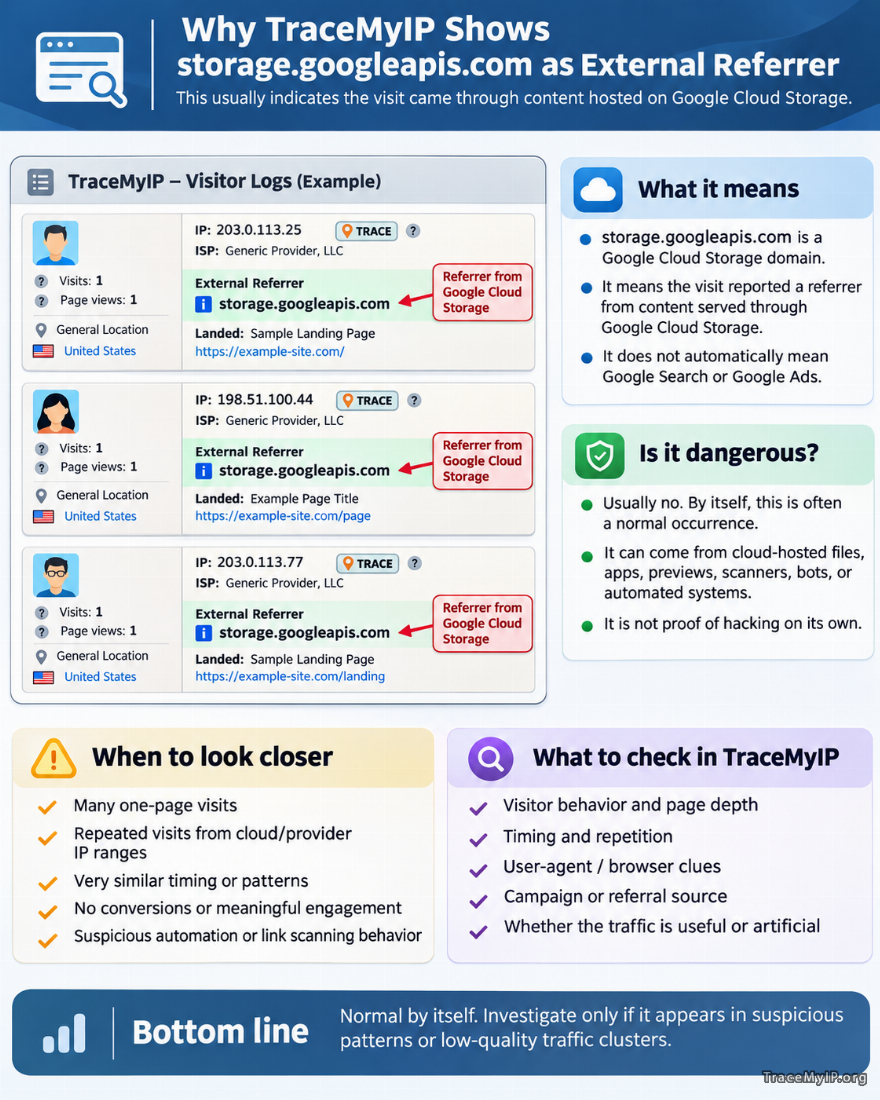 In many cases this is a normal occurrence. At the same time, Google Cloud infrastructure can also be used by applications, automated browsers, link scanners, crawlers, AI agents, and other software. For that reason, the referrer should be interpreted together with the visitor’s behavior rather than treated by itself as proof that the visit was either human or automated.
📈 Sign Up now to instantly track website visitors IPs!
What storage.googleapis.com means in an external referrer
storage.googleapis.com is a Google Cloud Storage domain used to access objects stored in Google’s cloud infrastructure. Those objects can include documents, web files, application resources, downloads, data files, and other content published or used by organizations and applications that rely on Google Cloud.
When a browser or another web client follows a link from one page to another, it can send referral information with the request. That information tells the destination website where the navigation originated. TraceMyIP can display available referral information in the visitor log as an External Referrer.
If the visitor record shows:
External Referrer: storage.googleapis.com
the practical meaning is that the visit reported Google Cloud Storage as the referring origin or page source.
This does not mean that Google itself necessarily sent the visitor. Google Cloud Storage is infrastructure that can be used by many unrelated customers, developers, websites, services, and applications.
Why a visitor might arrive from Google Cloud Storage
There are several legitimate ways a website visit can originate from content stored on Google Cloud Storage.
- A person may click a link contained in a web page or document hosted through Google Cloud Storage.
- An application may store HTML, documents, reports, or other content in a Cloud Storage bucket that contains a link to your website.
- A cloud-hosted system may generate pages or resources that direct users to an external website.
- A preview, notification, publishing, or content-processing system may access a link associated with a stored object.
- A developer or organization may use Google Cloud Storage as part of its normal website or application infrastructure.
In these cases, storage.googleapis.com can appear in the same way that another website’s domain might appear as an external referrer.
The referrer may show only the domain rather than the complete originating URL. Modern browsers and websites can restrict how much referral information is transmitted between different domains for privacy reasons. Therefore, seeing only storage.googleapis.com does not necessarily mean that more detailed source information was available to the destination website.
Does storage.googleapis.com mean the visitor came from Google Search?
No. A referral from storage.googleapis.com should not automatically be interpreted as traffic from Google Search.
Google Search referrals, Google Ads traffic, Google Cloud infrastructure, and Google Cloud Storage are different sources of activity even though they are all associated with Google-operated infrastructure or domains.
A Cloud Storage referrer indicates the reported origin of the navigation. It does not by itself establish that the visit came from:
- Google Search;
- Google Ads;
- Googlebot;
- a Google employee;
- a particular Google application; or
- a human visitor.
The same distinction applies if the visitor’s ISP or network information also identifies Google. A connection originating from Google-operated IP space does not automatically identify the software or person using that infrastructure.
Can storage.googleapis.com traffic be automated?
Yes. Some visits showing a Google Cloud Storage referrer may be generated by automated systems.
Cloud platforms are widely used for software automation. A program can retrieve a stored file, inspect its contents, follow links, launch a browser, or perform other web activity without a person manually clicking each link.
Possible sources of automated traffic include:
- link scanners;
- content indexing systems;
- website crawlers;
- preview generators;
- monitoring applications;
- cloud scripts;
- automated browsers;
- AI-controlled browser agents;
- security scanners; and
- other software that retrieves or follows links.
Modern automation can also operate a real browser, execute JavaScript, accept cookies, and load complete webpages. This can make some automated visits look much more like ordinary browser traffic than older bots that simply requested HTML files.
For this reason, the referrer alone is not enough to determine whether a particular visit represents a person, a legitimate automated service, or unwanted artificial traffic.
Is this traffic dangerous?
Usually, seeing storage.googleapis.com as an external referrer is not dangerous by itself. It is a referral source, not a security warning.
A normal page request from Google Cloud infrastructure does not mean that your website has been compromised. It also does not mean that the visitor obtained access to private information or administrative areas of the website.
The more useful question is what the visitor actually did after reaching the site.
A single visit that loads an ordinary public page and produces no unusual activity is generally not a reason for concern. Repeated or unusual behavior, however, can justify additional investigation regardless of whether the referrer is Google Cloud Storage, another cloud provider, a search engine, or an ordinary website.
When to examine the traffic more closely
Look beyond the referrer and examine the pattern of visits when you see a large number of records associated with storage.googleapis.com.
Patterns worth investigating can include:
- many visits occurring within a very short period;
- large numbers of one-page visits;
- repeated requests for exactly the same landing page;
- multiple visitors showing nearly identical behavior;
- large groups of visits from cloud-hosting or data-center networks;
- activity occurring at highly regular intervals;
- no navigation beyond the initial landing page;
- no conversions or other meaningful interaction despite high traffic volume;
- requests for unusual files, administrative pages, login pages, or nonexistent URLs; and
- traffic patterns that continue at a volume inconsistent with normal website activity.
None of these characteristics independently proves malicious activity. For example, a legitimate monitoring service or link checker might repeatedly request one page. The pattern becomes more informative when several characteristics occur together.
How to evaluate these visitors in TraceMyIP logs
When a storage.googleapis.com referral appears in TraceMyIP, use the rest of the visitor record to put the referral into context.
Useful details to compare include:
- the landing page;
- number of visits;
- number of page views;
- timing of the visits;
- network or ISP information;
- browser and user-agent information when available;
- referral source;
- subsequent pages viewed;
- repeat visits; and
- whether the activity leads to meaningful browsing or conversions.
One isolated record normally provides much less information than a repeated pattern. If dozens of records arrive within a narrow timeframe, use the same referrer, request the same page, and produce no further navigation, that traffic deserves more scrutiny than a single visitor who arrives once and proceeds through several pages.
Why several records may show Google as the ISP
You may occasionally see storage.googleapis.com as the external referrer while the visitor’s network or ISP information also identifies Google.
This combination can occur when the request itself originates from infrastructure operated by Google. For example, an application, automated workload, or other service running within Google’s infrastructure may access your website while processing cloud-hosted content.
However, the combination still does not identify the specific application responsible for the request. Google operates infrastructure used by many different services and customers. An IP address associated with Google should therefore not automatically be labeled as Googlebot, Google Search, or another particular Google product.
Look at the complete visitor behavior before assigning a specific explanation to the traffic.
Can the external referrer be trusted completely?
Referral information is useful, but it should not be treated as an authenticated identity.
Browsers can limit referral information according to privacy policies. Some software sends no referrer at all. Other applications may send only the originating domain instead of a complete URL. Automated clients can also construct HTTP requests themselves, which means referral information can sometimes be modified or supplied programmatically.
For this reason, an external referrer is best treated as one piece of evidence about the visit.
A stronger analysis combines the referrer with visitor behavior, request timing, network information, page depth, repeat activity, and other available information.
Should storage.googleapis.com be blocked?
Do not block traffic solely because storage.googleapis.com appears as the referrer.
There can be legitimate visitors and applications behind Google Cloud-hosted content. Blocking an entire cloud-related source based only on its referrer could interfere with valid referrals without addressing the actual source of unwanted requests.
If you are experiencing abusive traffic, identify the behavior first. Determine whether the requests are repetitive, excessive, targeting sensitive locations, consuming significant resources, or otherwise behaving differently from ordinary visitors.
Security-related blocking decisions are better based on the actual network source, request behavior, server logs, rate patterns, authentication failures, or other security evidence rather than a single referrer value.
If suspicious requests are targeting your website, review the controls provided by your hosting company, firewall, content delivery network, web application firewall, or server configuration. Campaign and visitor analytics can help identify unusual patterns, but website security controls should be applied at the appropriate hosting or network layer.
What the example visitor pattern can tell you
A pattern consisting of multiple visitors arriving close together, each viewing a single page, with storage.googleapis.com repeatedly listed as the referrer can reasonably be investigated as possible automated or cloud-generated activity.
That pattern still does not prove that the visits are malicious. Possible explanations include automated link checking, document processing, preview generation, legitimate software activity, crawlers, browser agents, or other cloud-based systems.
The important distinction is between source and behavior. The referrer tells you something about where the navigation reportedly originated. The visitor record tells you what happened after the request reached your website.
For traffic analysis, behavior is usually more useful than the reputation of a domain name alone.
Quick interpretation guide
| What you see | What it generally means |
|---|---|
storage.googleapis.com as External Referrer |
The request reported content served through Google Cloud Storage as its referring source. |
| Google listed as ISP or network | The request appears to originate from network infrastructure operated by Google. This does not identify the particular application or user. |
| One ordinary page visit | Usually not enough information to indicate anything unusual. |
| Many similar one-page visits | May justify checking for automation, scanners, crawlers, previews, or other repetitive activity. |
| No additional page views | Could be a short human visit or an automated request; examine the broader pattern. |
| Repeated visits at similar intervals | Can be a sign of automated activity, though legitimate monitoring systems can behave similarly. |
| Referrer plus normal multi-page browsing | More consistent with an engaged visitor, although no single behavior proves that a visitor is human. |
Bottom line
storage.googleapis.com is a normal Google Cloud Storage domain. Its appearance as an external referrer in TraceMyIP is not, by itself, evidence of hacking, malware, invalid advertising traffic, or another security problem.
It means that the request reported Google Cloud Storage as the referring source. The actual visitor could be a person following a link, an application, a link scanner, a crawler, an automated browser, an AI agent, or another system interacting with content hosted through Google Cloud.
Use the referrer as one part of the visitor record. If the traffic appears isolated and behaves normally, there is generally little reason for concern. If you see large clusters of nearly identical requests, repeated one-page visits, abnormal timing, or other unusual behavior, examine the associated visitor records and your server-side traffic before deciding whether action is necessary.
🌍 Who visits your website? Sign Up now to find out instantly!